
Regional aid in Poland: use the map to compare investment locations

Reviewed: 13 October 2026 · Polish law and taxation
Two similarly priced industrial sites can produce different state-aid ceilings. That does not make the location with the highest percentage the automatic choice. An investment decision should combine the applicable aid intensity with infrastructure costs, labour availability and the ability to use a tax exemption. The regional aid map is the starting point for the financial assessment, rather than its conclusion.
Regional aid map 2026–2027: what support can the location qualify for?
Determine the rate for the actual investment site, including the subregion or municipality. This map and table reflect the rules checked on 1 November 2026 under §2 and the Annex to the Regulation of 14 December 2021, consolidated in Dz.U. 2026 item 1117. Under §9 the map remains applicable until 31 December 2027.
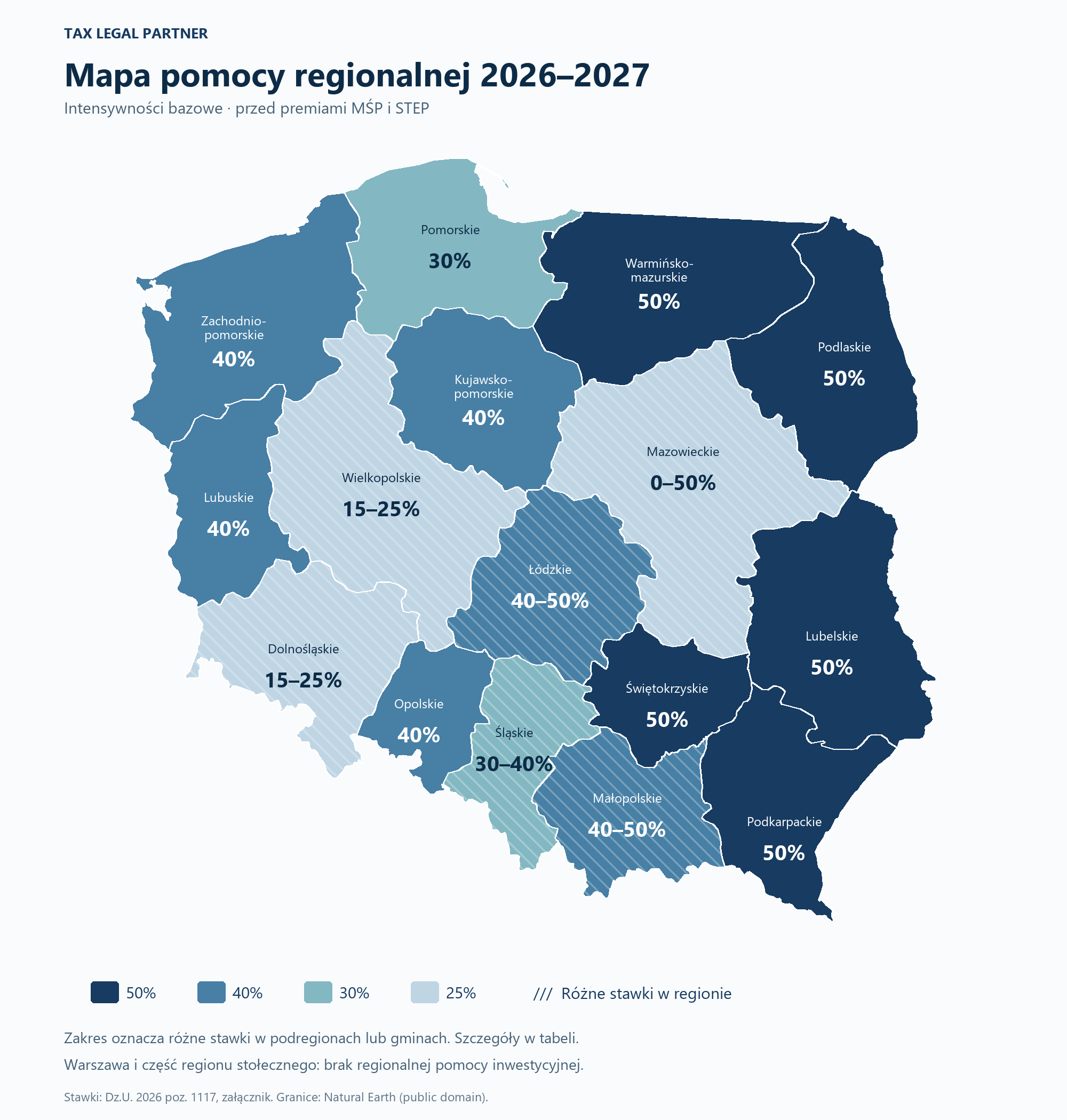
Base rates and uplifts for medium-sized and small enterprises
| Investment location | Base rate / large enterprise | Medium enterprise | Small / micro enterprise |
|---|---|---|---|
| Lubelskie, Podkarpackie, Podlaskie, Świętokrzyskie, Warmińsko-mazurskie | 50% | 60% | 70% |
| Siedlecki subregion (PL925) | 50% | 60% | 70% |
| Kujawsko-pomorskie, Lubuskie, Opolskie, Zachodniopomorskie | 40% | 50% | 60% |
| Łódzkie — municipalities and cities listed below | 50% | 60% | 70% |
| Łódzkie — remaining territory | 40% | 50% | 60% |
| Małopolskie — Oświęcimski subregion (PL21A) | 50% | 60% | 70% |
| Małopolskie — outside Oświęcimski | 40% | 50% | 60% |
| Śląskie — Katowicki, Sosnowiecki, Tyski, Bielski, Rybnicki, Bytomski and Gliwicki subregions | 40% | 50% | 60% |
| Śląskie — remaining territory | 30% | 40% | 50% |
| Pomorskie | 30% | 40% | 50% |
| Mazowiecki regionalny — excluding Siedlecki | 40% | 50% | 60% |
| City of Poznań, Poznański subregion and city of Wrocław — 2025–2027 rate | 15% | 25% | 35% |
| Remaining Wielkopolskie and Dolnośląskie | 25% | 35% | 45% |
| Warszawski wschodni — only the 13 listed municipalities | 35% | 45% | 55% |
| Warszawski zachodni — only the 13 listed municipalities | 25% | 35% | 45% |
| Warsaw and remaining Warszawski stołeczny territory | No regional aid | No regional aid | No regional aid |
SME columns calculate the §4 uplift: 10 percentage points for medium enterprises and 20 for small, including micro. The uplift excludes new investments whose eligible costs exceed EUR 50 million. The table excludes the separate STEP uplift and further restrictions of the relevant scheme.
Which municipalities and subregions have special rates?
Łódzkie: 50% in these municipalities: Wola Krzysztoporska, Rozprza, Bełchatów, Drużbice, Kleszczów, Kluki, Rusiec, Szczerców, Zelów, Gorzkowice, Dobryszyce, Gomunice, Kamieńsk, Lgota Wielka, Ładzice, Radomsko, Działoszyn, Kiełczygłów, Nowa Brzeźnica, Pajęczno, Rząśnia, Siemkowice, Strzelce Wielkie, Sulmierzyce, Czarnożyły, Konopnica, Osjaków, Ostrówek, Wieluń, Wierzchlas, Widawa, Złoczew; and these cities: Piotrków Trybunalski, Bełchatów, Radomsko.
Warszawski wschodni: 35% only in these municipalities: Serock, Dobre, Kałuszyn, Latowicz, Mrozy, Siennica, Kołbiel, Osieck, Sobienie-Jeziory, Dąbrówka, Jadów, Strachówka, Tłuszcz.
Warszawski zachodni: 25% only in these municipalities: Baranów, Błonie, Góra Kalwaria, Grodzisk Mazowiecki, Jaktorów, Kampinos, Leoncin, Leszno, Nasielsk, Prażmów, Tarczyn, Zakroczym, Żabia Wola.
Śląskie: 40% in these subregions: Katowicki (PL22A), Sosnowiecki (PL22B), Tyski (PL22C), Bielski (PL225), Rybnicki (PL227), Bytomski (PL228), Gliwicki (PL229).
When do SME, Just Transition Fund and STEP uplifts apply?
SME status follows state-aid rules, including partner and linked enterprises. Section 4 adds percentage points: 40% plus 10 points gives 50%, not 44%. An SME uplift does not create regional investment aid in an area excluded from the map.
The Just Transition Fund increases are already included: 50% in the listed parts of Łódzkie and Małopolskie and 40% in the listed Śląskie subregions. Do not add another 10 points for the same ground. Separately, §3a provides qualifying STEP investments with 10 additional points in Article 107(3)(a) TFEU areas and 5 in Article 107(3)(c) areas. Check the investment and the conditions of the instrument providing the aid.
Location and company size: numerical examples
Assume a medium enterprise with PLN 10 million eligible investment. Toruń has 40% base intensity plus 10 SME points: 50%, or a nominal PLN 5 million ceiling. The city of Wrocław has 15% plus 10 points: 25%, or PLN 2.5 million. The difference is PLN 2.5 million at the same cost. Eligibility, no STEP and no other aid for these costs are assumed. Discounting is excluded and full utilisation is not guaranteed.
The map sets the maximum regional investment aid intensity (§ 2, § 6, § 9). PSI also requires checks of eligible activity, the new investment, grant date, cumulation and large-project rules. Distinguish the map period ending 31 December 2027 from the period for using an individual support decision. Sources reviewed: 1 November 2026.
Identify the exact area and period
Poland's regional aid map for 2022–2027 sets out eligible areas and maximum intensities. Its consolidated text was published in the Polish Journal of Laws in 2026, item 1117. The map distinguishes not only provinces but also subregions and specified municipalities. A province name in a property presentation is therefore insufficient to confirm the applicable ceiling.
For example, the base intensity in Małopolskie is 40%, while the Oświęcimski subregion has 50%. For the city of Wrocław, the rate for 2025–2027 is 15%, compared with 25% in the Wrocławski subregion. These are starting rates for the specified areas, before examining increases and project-specific rules. A site near a city does not necessarily have the city's rate.
Enterprise size changes the calculation
Small enterprises generally benefit from a 20-percentage-point increase and medium-sized enterprises from a 10-point increase, subject to the statutory investment-cost restrictions. Classification requires employee and financial data together with the relevant relationships to other businesses. Small-taxpayer status for Polish CIT is not the same as small-enterprise status for state aid.
Foreign group links can change the classification of a Polish subsidiary. The assessment must also cover the activity, large-investment-project rules and any specific increases, including those available for qualifying STEP investments. Calling a project innovative does not establish eligibility for an enhanced rate. Each increase needs a legal basis and evidence that its conditions are satisfied.
A percentage is not a cash payment
The applicable intensity and eligible expenditure provide an initial aid ceiling. A complete calculation must also address discounting, accumulation of aid and programme-specific limits. Total project expenditure may exceed eligible costs. A grant and a tax exemption supporting the same costs do not automatically create two separate, fully available ceilings.
Within the Polish Investment Zone, support is realised through an exemption for income covered by the legislation and support decision. Insufficient eligible profits may prevent the company from using its entire aid capacity. Compare the income forecast, decision duration and continuing commitments rather than treating the maximum spreadsheet figure as an amount that will necessarily be received.
Illustrative example: sites A and B
An investor compares two sites with provisionally established aid intensities of 40% and 50%. On assumed eligible expenditure of PLN 10 million, simple multiplication gives PLN 4 million and PLN 5 million. These are illustrative amounts before further adjustments, not verified awards or cash reimbursements.
Site B, however, requires a more expensive utility connection and delays the start of production. The financial comparison sets those costs against the likely use and timing of the exemption. The higher ceiling may remain attractive, but it does not settle the location decision. Planning permission, road access, energy capacity and realistic staffing availability also need separate checks.
Check the investment type, not only aid intensity
In areas covered by Article 107(3)(c) TFEU, Article 14 GBER limits support for large enterprises to initial investment creating a new economic activity in the area. Increasing an existing plant’s capacity can therefore require a different conclusion from establishing a qualifying new activity. Determine the area category, enterprise size and project type before calculating the ceiling. SME status combines staff requirements with the applicable financial threshold and the relevant partner and linked-enterprise data.
Prepare a location-comparison file
- Identify the exact plots, municipalities and applicable area codes.
- Establish enterprise size, including relevant group relationships.
- Separate total expenditure from eligible costs.
- List other aid and forecast qualifying income.
- Compare operating costs, delivery dates and support conditions.
Send TLP the candidate locations, project budget and ownership structure. These inputs allow the applicable ceiling to be checked and the options compared against commercial feasibility. The rules and map relevant at the time aid is granted should be reconfirmed before the final investment assumptions are approved.
Tax rulings and case law reviewed: 1 November 2026.
Investment costs, decision territory and group size: lessons from aid disputes
A support decision involves separate calculations of eligible investment, permitted aid and income actually exempt. Company size must also include relevant group relationships. Check these elements before finalising the budget.
Solar panels, parking and staff facilities as investment costs
In 0111-KDIB1-3.4010.651.2026.1.DW of 2026-10-28, KIS accepted the described solar installation for own consumption, parking and staff facilities as eligible elements of the new investment. They were integral to the supported project and served activity within the relevant territory. For Article 17(1)(34a) CIT and the public-aid regulation’s cost catalogue, explain each expenditure’s function. An item need not independently manufacture a product, but its connection with the approved project must be documented.
Ancillary storage differs from production outside the decision territory
In 0111-KDIB1-3.4010.620.2026.1.DW of 2026-10-08, KIS distinguished supporting storage from production carried out at a plant outside the support decision’s territory. Income from that external production did not become exempt merely because the company held a decision. The model should identify where stages occur, the warehouse’s role and revenue and cost allocation. Reconcile the decision’s territory and activities with the actual process before applying Article 17(4) CIT.
An SEZ permit and a support decision: common records and chronological use
Ruling 0111-KDIB1-3.4010.288.2025.11.DW of 2026-10-22 was reissued following the taxpayer’s court success. KIS accepted, on the stated conditions, common records of exempt activity covered by an SEZ permit and a support decision, with chronological use of aid limits. Each instrument’s amount, validity and utilisation must remain traceable. A common tax result does not eliminate separate tracking of the legal basis, territory and activity underlying each allocation of aid.
Factory support facilities can form part of the new investment
In I SA/Łd 632/24 of 2024-11-19, the court quashed a ruling restricting eligible costs to items directly increasing production. Under the applicable 2018 regulation, authorities could not add a further test to §8 that excluded expenditure enabling an independent business within the decision’s activities and territory. Administrative explanations could not amend the legal catalogue. Establish the applicable regulation and decision date, then demonstrate each asset’s role in the overall project.
Why KIS reconsidered combined SEZ and PSI records
On 28 May 2026, the Supreme Administrative Court dismissed the authority’s appeal in II FSK 127/26, concerning common records of exempt SEZ and PSI activities. The linked reissued ruling 0111-KDIB1-3.4010.288.2025.11.DW records the outcome and implementation. A coherent accounting model must preserve chronological use of individual limits alongside the exempt result. Reorganisations or additional decisions should prompt a check that each aid instrument and covered activity remains identifiable.
Family businesses and common management: when must figures be aggregated?
In C-110/13, HaTeFo of 2014-02-27, the CJEU examined SME status for public aid. Separate businesses may form one economic unit through coordinated individuals and organisational and economic dependencies. Neither a special agreement nor an intention to circumvent thresholds is required, but family ties alone do not replace examination of the relationship. The case informs group-size analysis for regional aid and KSC; it does not decide obligations under Poland’s 2026 KSC amendment.
An aid ceiling is not an automatic cash saving
Assume PLN 20 million eligible expenditure and, solely for illustration, 50% aid intensity. The initial ceiling is PLN 10 million before required discounting and cumulation rules. Annual qualifying exempt profit of PLN 4 million at 19% CIT saves PLN 760,000, or PLN 3.8 million over five such years. Unused capacity is not a state payment. Actual intensity depends on location, company size and project type; validity and other aid for the same costs must also be considered.
Frequently asked questions
Does the regional aid map guarantee an aid amount?
No. It sets maximum intensity for the area and period. Eligible costs, enterprise size, programme rules, aid cumulation and use of the tax exemption still affect the result.
Is checking the voivodeship enough?
Not always. Subregions and municipalities may have different rates. Confirm the exact site and the rules applicable when aid is granted.
Is the highest percentage always the best location?
No. Compare infrastructure, staff availability, launch timing, operating costs and forecast income. A higher ceiling does not guarantee a larger usable benefit.
Full guide to Polish Investment Zone conditions
Discuss your Polish tax or legal question
Briefly describe your business in Poland, the decision you face and the countries involved. We will agree the scope, consultation language and information needed before the analysis.
Write to us
- Location, investment type, budget and group structure.
- Project stage and any signed orders, agreements or support decisions.
About the author

Sources and further reading
- Regional aid map 2022–2027 — Dz.U. 2026, poz. 1117; consolidated text
- Polish New Investment Support Act — Dz.U. 2025, poz. 469; consolidated text
- Polish Investment Zone regulation — Dz.U. 2025, poz. 108; consolidated text
- GBER — Regulation (EU) No 651/2014, consolidated text — EUR-Lex, HTML — art. 2, 6, 14; Annex I
- GBER — Regulation (EU) No 651/2014, consolidated text — Publications Office, PDF — art. 2, 6, 14; Annex I
Information material. An assessment of a particular situation requires its facts and the rules applicable to the relevant period.