
Polish Investment Zone: preparing the support decision before investment

Reviewed: 13 October 2026 · Polish law and taxation
The right time to assess the Polish Investment Zone is while the project and purchasing timetable can still change. A binding equipment order may matter more than the date of the first invoice. Before committing funds, investors should establish whether the project is a qualifying new investment, which support conditions are achievable and how the application fits into the delivery schedule.
Understand what the support provides
The Polish Investment Zone, commonly abbreviated PSI, provides support through an income-tax exemption based on a support decision. It is not an automatic reimbursement of a percentage of capital expenditure. Its value depends on eligible income, the available aid ceiling and compliance with the decision. The tax forecast should therefore be developed alongside the investment budget.
Support decisions run for 12, 14 or 15 years under the applicable location and programme rules. This does not mean that all company income is exempt throughout that period. The authorised activity, area and connection between income and the new investment must be identified. Where taxable and exempt activities coexist, revenue and costs require a defensible allocation method.
Establish whether the project is a new investment
The Polish legislation includes establishing a new plant, increasing production capacity, diversifying output and fundamentally changing a production process. Replacing a worn machine should not automatically be described as a qualifying investment. The company should explain the actual change in capacity, products or process and identify the expenditure that forms part of that change.
The assessment then covers excluded activities, quantitative and qualitative criteria, and enterprise size. SME status must take the relevant partner and linked enterprises into account, including foreign connections. A small Polish subsidiary can form part of a large enterprise for state-aid purposes. The group ownership chart is therefore a substantive input, not merely an administrative attachment.
Regional aid map 2026–2027: what support can the location qualify for?
Before applying for a support decision, identify the parcels within the aid map and establish enterprise size including the group. Cite the relevant Annex entry rather than copy a percentage from an investment presentation. The diagram reflects consolidated regulation Dz.U. 2026 item 1117.
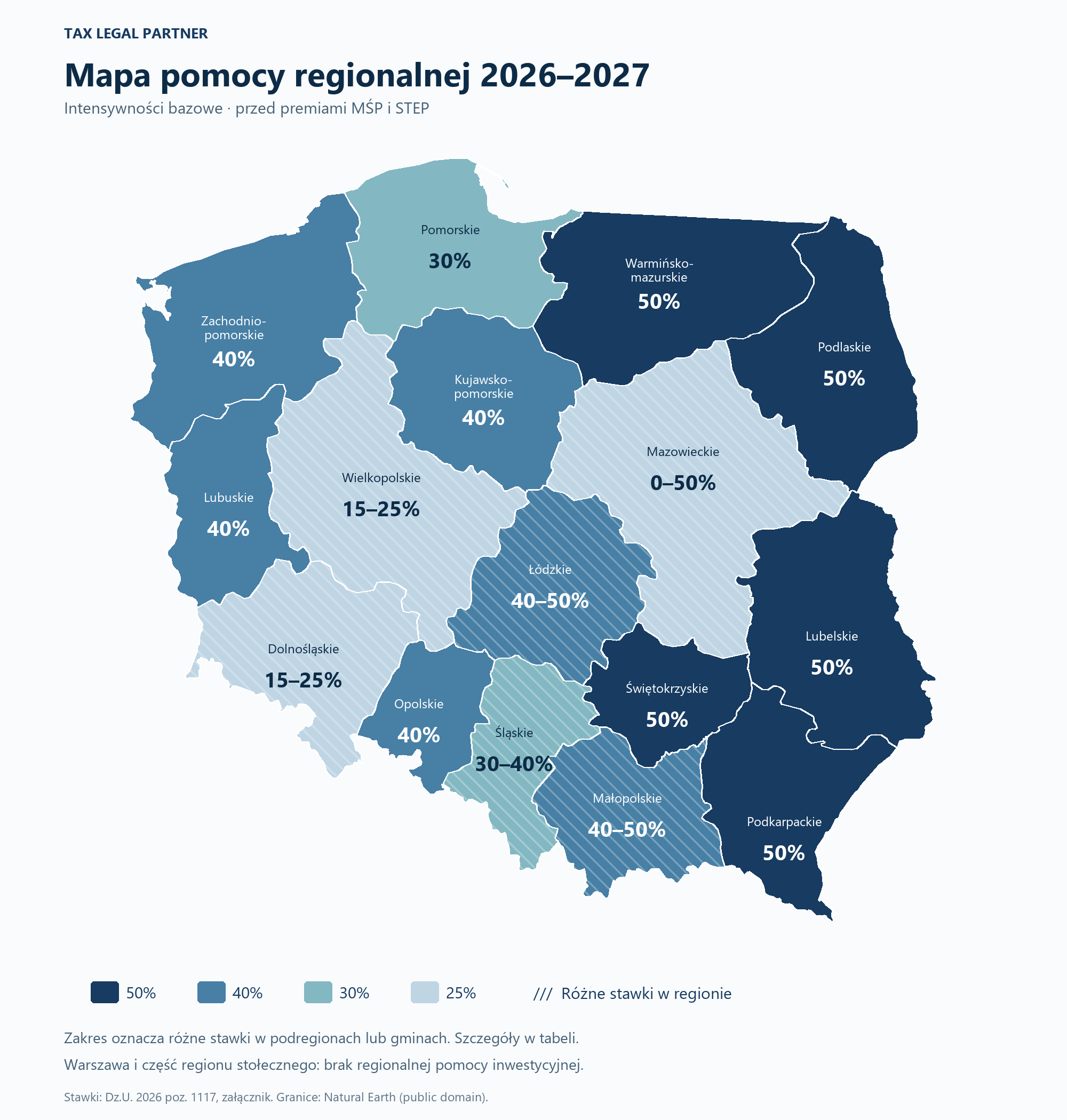
See the rate table, municipality lists and location examples. Regulation and statutory Annex.
When do SME, Just Transition Fund and STEP uplifts apply?
SME status follows state-aid rules, including partner and linked enterprises. Section 4 adds percentage points: 40% plus 10 points gives 50%, not 44%. An SME uplift does not create regional investment aid in an area excluded from the map.
The Just Transition Fund increases are already included: 50% in the listed parts of Łódzkie and Małopolskie and 40% in the listed Śląskie subregions. Do not add another 10 points for the same ground. Separately, §3a provides qualifying STEP investments with 10 additional points in Article 107(3)(a) TFEU areas and 5 in Article 107(3)(c) areas. Check the investment and the conditions of the instrument providing the aid.
Location and company size: numerical examples
A medium enterprise’s qualifying PLN 10 million investment in Toruń starts with 40% plus 10 SME points: 50%, or nominally PLN 5 million. Use consistent data in the application, financing plan and aid-utilisation records. Then reconcile eligible costs, other instruments and discounting rules. Eligibility and no STEP uplift are assumed.
The map sets the maximum regional investment aid intensity (§ 2, § 6, § 9). PSI also requires checks of eligible activity, the new investment, grant date, cumulation and large-project rules. Distinguish the map period ending 31 December 2027 from the period for using an individual support decision. Sources reviewed: 1 November 2026.
Review the sequence before issuing an order
EU incentive-effect rules make timing important. Starting work can include construction or the first legally binding equipment order or other commitment that makes an investment irreversible. Purchasing land and certain preparatory work are generally treated differently. The legal effect of each document matters more than its title or whether an advance has already been paid.
A prudent schedule provides for eligibility review, an application before work starts and a support decision before costs intended to qualify are incurred. Filing an application does not itself create the exemption. If contracts have already been signed, reconstruct the commitments and dates rather than assuming that an unpaid invoice solves the problem. Documents should reflect what actually happened throughout the project.
Illustrative example: an additional production line
A manufacturer plans to expand capacity and order equipment in several months. The team aligns supplier milestones with the support-decision timetable, identifies eligible expenditure and tests whether the proposed qualitative commitments can be maintained. A forecast estimates how much exempt income the investment could generate and how quickly the aid ceiling might be used.
Lower earnings do not automatically make the project unsuitable, but they change the timing and value of the benefit. The investor should also consider what happens if construction is delayed, the product mix changes or planned jobs are not created. The support conditions need to remain workable after the application has been approved.
Include investment retention and funding sources
Article 14 GBER generally requires the investment to remain in the area for at least 5 years after completion, or 3 years for SMEs. The beneficiary must also provide at least 25% of eligible costs through own resources or external financing free of public financial support. A commercial loan may require a different assessment from aid-supported financing. Map the funding sources and post-completion commitments and reconcile them with the support decision.
Prepare the review package
- Describe the production or technological change.
- Identify the site, plots and intended land use.
- Provide the budget, quotations, contracts and order timetable.
- Map the group and establish enterprise size.
- Forecast income and disclose other aid for the project.
Send these materials to TLP before signing the principal purchase commitments. They allow the team to assess PSI availability and sequence the necessary steps. The review should also address how the exemption will be accounted for and monitored after the decision, including the consequences of failing to meet its conditions.
Tax rulings and case law reviewed: 1 November 2026.
Investment costs, decision territory and group size: lessons from aid disputes
A support decision involves separate calculations of eligible investment, permitted aid and income actually exempt. Company size must also include relevant group relationships. Check these elements before finalising the budget.
Solar panels, parking and staff facilities as investment costs
In 0111-KDIB1-3.4010.651.2026.1.DW of 2026-10-28, KIS accepted the described solar installation for own consumption, parking and staff facilities as eligible elements of the new investment. They were integral to the supported project and served activity within the relevant territory. For Article 17(1)(34a) CIT and the public-aid regulation’s cost catalogue, explain each expenditure’s function. An item need not independently manufacture a product, but its connection with the approved project must be documented.
Ancillary storage differs from production outside the decision territory
In 0111-KDIB1-3.4010.620.2026.1.DW of 2026-10-08, KIS distinguished supporting storage from production carried out at a plant outside the support decision’s territory. Income from that external production did not become exempt merely because the company held a decision. The model should identify where stages occur, the warehouse’s role and revenue and cost allocation. Reconcile the decision’s territory and activities with the actual process before applying Article 17(4) CIT.
An SEZ permit and a support decision: common records and chronological use
Ruling 0111-KDIB1-3.4010.288.2025.11.DW of 2026-10-22 was reissued following the taxpayer’s court success. KIS accepted, on the stated conditions, common records of exempt activity covered by an SEZ permit and a support decision, with chronological use of aid limits. Each instrument’s amount, validity and utilisation must remain traceable. A common tax result does not eliminate separate tracking of the legal basis, territory and activity underlying each allocation of aid.
Factory support facilities can form part of the new investment
In I SA/Łd 632/24 of 2024-11-19, the court quashed a ruling restricting eligible costs to items directly increasing production. Under the applicable 2018 regulation, authorities could not add a further test to §8 that excluded expenditure enabling an independent business within the decision’s activities and territory. Administrative explanations could not amend the legal catalogue. Establish the applicable regulation and decision date, then demonstrate each asset’s role in the overall project.
Why KIS reconsidered combined SEZ and PSI records
On 28 May 2026, the Supreme Administrative Court dismissed the authority’s appeal in II FSK 127/26, concerning common records of exempt SEZ and PSI activities. The linked reissued ruling 0111-KDIB1-3.4010.288.2025.11.DW records the outcome and implementation. A coherent accounting model must preserve chronological use of individual limits alongside the exempt result. Reorganisations or additional decisions should prompt a check that each aid instrument and covered activity remains identifiable.
Family businesses and common management: when must figures be aggregated?
In C-110/13, HaTeFo of 2014-02-27, the CJEU examined SME status for public aid. Separate businesses may form one economic unit through coordinated individuals and organisational and economic dependencies. Neither a special agreement nor an intention to circumvent thresholds is required, but family ties alone do not replace examination of the relationship. The case informs group-size analysis for regional aid and KSC; it does not decide obligations under Poland’s 2026 KSC amendment.
An aid ceiling is not an automatic cash saving
Assume PLN 20 million eligible expenditure and, solely for illustration, 50% aid intensity. The initial ceiling is PLN 10 million before required discounting and cumulation rules. Annual qualifying exempt profit of PLN 4 million at 19% CIT saves PLN 760,000, or PLN 3.8 million over five such years. Unused capacity is not a state payment. Actual intensity depends on location, company size and project type; validity and other aid for the same costs must also be considered.
Frequently asked questions
When should the support-decision analysis begin?
Before the project becomes irreversible. Check the incentive effect before construction or binding orders. Plan the application and decision around expenditure intended to qualify for support.
Is the Polish Investment Zone a machinery grant?
No. It exempts specified income from CIT or PIT within the aid ceiling and decision conditions. The business needs qualifying income to use the exemption.
Is a small Polish subsidiary always an SME?
No. Partner and linked enterprises, including foreign group companies, must be considered. Figures for the Polish subsidiary alone may not establish SME status.
Full guide to Polish Investment Zone conditions
Discuss your Polish tax or legal question
Briefly describe your business in Poland, the decision you face and the countries involved. We will agree the scope, consultation language and information needed before the analysis.
Write to us
- Location, investment type, budget and group structure.
- Project stage and any signed orders, agreements or support decisions.
About the author

Sources and further reading
- Polish New Investment Support Act — Dz.U. 2025, poz. 469; consolidated text
- Polish CIT Act — art. 17 — Dz.U. 1992, poz. 86; ELI unified text
- Polish Investment Zone regulation — Dz.U. 2025, poz. 108; consolidated text
- Polish Investment Zone regulation — Dz.U. 2025, poz. 833; promulgated text
- GBER — Regulation (EU) No 651/2014, consolidated text — EUR-Lex, HTML — art. 2, 6, 14; Annex I
- GBER — Regulation (EU) No 651/2014, consolidated text — Publications Office, PDF — art. 2, 6, 14; Annex I
Information material. An assessment of a particular situation requires its facts and the rules applicable to the relevant period.